
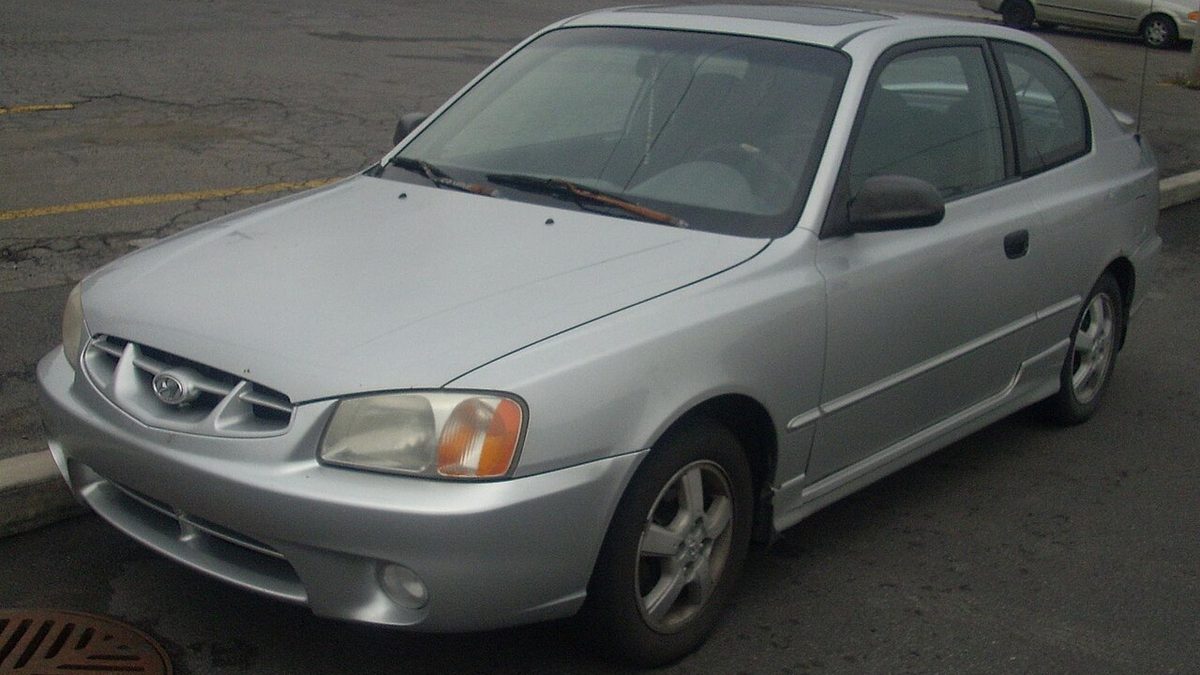
The 2000–2002 Hyundai Accent is still a common sight on the road: simple, cheap to run and easy to work on. Most of these cars have changed hands several times, and the owner's manual is often long gone. This post collects the practical technical information from the 2000 Accent owner's manual: which fluids go where and how much, when each service is due, what the warning lights mean, and what to do when you are stuck at the roadside.
The figures come from Hyundai's owner's manual for the 2000 Accent, written for the US-market petrol car. I have added metric units alongside. Engines and equipment differ between markets, so always check your own car's labels (tire pressure, oil filler cap) and service history first. This is not an official Hyundai publication.
Fluids and capacities
| Item | Specification | Capacity |
|---|---|---|
| Engine oil | API SG / SH multigrade. Above −23 °C (−10 °F): 10W-30, 10W-40 or 10W-50; 5W-30 in cold climates | 3.3 L (3.49 US qt) with filter · 3.0 L without |
| Manual transaxle oil | API GL-4, SAE 75W/90 | 2.15 L (2.27 US qt) |
| Automatic transaxle fluid | Hyundai ATF SP-II M (or Diamond ATF SP-II M) | 6.7 L (7.08 US qt) |
| Engine coolant | Ethylene-glycol antifreeze for aluminium radiators | 5.5 L (5.7 US qt) |
| Brake fluid | DOT 3 | Between MIN and MAX |
| Power steering fluid | PSF-3 | 0.9 L (0.95 US qt) |
| Washer reservoir | Washer fluid (never coolant) | 3.0 L (3.2 US qt) |
| Fuel tank | Unleaded, 87 pump octane (91 RON) or higher | 45 L (11.9 US gal) |
Use only SP-II M type fluid in the automatic transaxle; other ATFs can damage it. Never mix anything into the brake fluid, as it ruins the seals, and keep it off the paint.
Coolant mix
Mix antifreeze with water. Keep the concentration between 35% and 60%.
| Lowest outside temperature | Antifreeze | Water |
|---|---|---|
| −15 °C (5 °F) | 35% | 65% |
| −25 °C (−13 °F) | 40% | 60% |
| −35 °C (−31 °F) | 50% | 50% |
| −45 °C (−49 °F) | 60% | 40% |
A 50/50 mix suits most climates. Check the level on the reservoir between LOW and FULL with the engine cold. Never open the radiator cap on a hot engine; the coolant is under pressure.
Service intervals
Whichever comes first: distance or time.
| Item | Normal use |
|---|---|
| Engine oil and filter | Replace every 12,000 km (7,500 mi) or 6 months |
| Cabin (evaporator) air filter | Replace every 15,000 km (9,000 mi) or 12 months |
| Air cleaner filter | Replace every 48,000 km (30,000 mi) or 24 months |
| Spark plugs | Replace every 48,000 km (30,000 mi) or 24 months |
| Engine coolant | Replace roughly every 48,000 km (30,000 mi) or 24 months |
| Fuel filter | Replace every 84,000 km (52,500 mi) or 42 months |
| Timing belt | Inspect every 48,000 km; replace every 96,000 km (60,000 mi) |
| Automatic transaxle fluid | Inspect every 12,000 km; replace at 168,000 km (105,000 mi) |
| Brake pads, rotors, calipers, brake lines | Inspect every 24,000 km (15,000 mi) |
| Brake fluid, rear drums, parking brake | Inspect every 48,000 km (30,000 mi) |
| Drive belts (alternator, water pump, A/C) | Inspect every 48,000 km (30,000 mi) |
| Exhaust, suspension bolts, driveshaft boots, A/C refrigerant | Inspect every 24,000 km (15,000 mi) |
| Steering gear, linkage, ball joints | Inspect every 24,000 km (15,000 mi) |
The timing belt matters most. A snapped belt can wreck the engine. If you don't know the car's history, replacing the timing belt kit right after buying is the safe choice.
Severe driving conditions
Repeated short trips, long idling, dusty or rough roads, salted winter roads, heavy city traffic in hot weather, and mountain driving all count as severe use. In that case:
- Change engine oil and filter every 4,800 km (3,000 mi) or 3 months.
- Change automatic transaxle fluid every 4,800 km (3,000 mi).
- Inspect driveshaft boots every 12,000 km or 6 months.
- Check the air filter, cabin filter, spark plugs, brakes and steering parts more often.
Engine and electrical data
| Spark plugs | NGK BKR5ES-11 or Champion RC10YC4 |
|---|---|
| Spark plug gap | 1.0–1.1 mm (0.039–0.043 in) |
| Firing order | 1-3-4-2 |
| Idle speed | 800 ± 100 rpm |
| Valve clearance | Hydraulic lifters, no adjustment |
| Battery | 12 V, 55 Ah, maintenance-free |
| Alternator | 13.5 V, 75 A |
| Headlight bulb | 60/55 W |
Change spark plugs on a cold engine, one at a time, so the leads don't get mixed up. Pull on the boot, not the wire. The cylinder head is aluminium, so don't overtighten the plugs.
Adjustment and free-play values
| Check | Spec |
|---|---|
| Steering wheel free play | Up to 30 mm (1.18 in) at the rim |
| Clutch pedal free play | 6–13 mm (0.24–0.51 in) |
| Brake pedal free play | 3–8 mm (0.12–0.31 in), engine off, after pumping out the vacuum |
| Brake pedal to floor | At least 70 mm (2.76 in) with the engine running and the pedal pressed firmly |
| Alternator belt deflection | 9.0–10.4 mm (0.35–0.41 in) |
| A/C belt deflection | About 8 mm (0.31 in) at 98 N (22 lb) |
| Wheel nut torque | 88–108 N·m (65–80 lb·ft) |
Tires
- Standard size 155/80 R13; options 175/70 R13 and 185/60 R14.
- The correct pressure is on the label on the driver's side door pillar or in the glove box. Check pressures cold, after the car has been parked for at least three hours.
- Rotate the tires every 12,000 km (7,500 mi); the temporary spare is not part of the rotation.
- Replace a tire when the tread is down to 1.6 mm and the wear bars show across two or more grooves.
- Fit winter tires on all four wheels and run them about 0.3 bar (4 psi) above the label pressure.
- Do not use snow chains with 175/65 R14 tires; there isn't enough clearance.
Temporary spare
The T105/70 D14 space-saver runs at 420 kPa (60 psi). Stay below 80 km/h (50 mph), don't fit chains to it, and don't use more than one at a time. Put the repaired tire back on as soon as you can, and check the spare's pressure once a month.
What the warning lights mean
| Light | Meaning | What to do |
|---|---|---|
| Oil pressure (oil can) | Not enough oil pressure | Stop immediately somewhere safe, switch off and check the oil level. If the level is fine and the light stays on, don't run the engine; have it towed. |
| Charging (battery) | The alternator isn't charging | Stop and check the alternator belt is present and tight. The car will die once the battery runs flat. |
| BRAKE | Parking brake on or brake fluid low | Check the parking brake. If it's off, check the fluid; a low level can mean a leak, so drive to a garage carefully. |
| CHECK (engine) | An emission-related fault | First tighten the fuel cap until it clicks three times. If it stays on, have the fault code read. |
| AIR BAG | Should flash for about 6 seconds at key-on | If it never lights or stays on, the airbag system may not work; have it checked. |
| ABS | ABS fault | Normal brakes still work, without anti-lock. |
| Temperature gauge near H | Engine overheating | Follow "If the engine overheats" below. |
| Low fuel | Tank nearly empty | Refuel soon. Running the tank dry can damage the catalytic converter. |
Roadside emergencies
Flat battery: jump starting
- The booster battery must be 12 V and the two cars must not touch. Switch off all unnecessary electrics.
- Connect the red lead to the + terminal of the flat battery, then to the + terminal of the booster battery.
- Connect the black lead to the booster battery's − terminal, and its other end to bare metal on your engine, away from the battery, not to the flat battery.
- Run the booster car for a few minutes, then start yours.
- Remove the leads in exactly the reverse order.
Battery gas is explosive; no smoking or sparks nearby. If acid gets on skin or in eyes, flush with water for at least 15 minutes and get medical help. Don't push- or tow-start the car; the catalytic converter can overheat and catch fire.
If the engine overheats
- Pull over safely, select neutral (P on an automatic), apply the parking brake and turn off the A/C.
- If steam or coolant is coming out, switch off and don't open the hood until it stops.
- If not, leave the engine running and check the cooling fan is turning. If it isn't, switch off.
- Check the water pump belt and look for leaks at the radiator and hoses. Water dripping after A/C use is normal.
- Once the engine has cooled, open the radiator cap slowly and fill the reservoir to the halfway mark. If it overheats again, stop driving.
Flat tire
- Lift off the throttle and keep the car straight; don't brake hard straight away. Once slow, pull off onto firm, level ground.
- Hazard lights on, parking brake on, P (or reverse on a manual). Get everyone out on the side away from traffic.
- Block the wheel diagonally opposite the flat.
- Loosen the wheel nuts half a turn with the car on the ground, then place the jack at the jacking point under the sill and raise the car.
- Swap the wheel, tighten the nuts by hand, lower the car and tighten them in a criss-cross order.
The jack handle is under the trunk mat. Never get under a car held only by the jack, and keep everyone out of the car while it's raised.
Towing
- A flatbed truck is the safest option for any Accent.
- Never tow an automatic Accent from the rear with the front wheels on the ground; it damages the transaxle. If you have to, put a dolly under the front wheels.
- With all four wheels on the ground, an automatic may only be towed from the front, in neutral, at up to 50 km/h (30 mph) for up to 25 km (15 mi), with the key in ACC so the steering stays unlocked.
- For emergency towing, attach the strap to the tie-down hook under the front bumper. Someone must sit in the towed car to steer and brake.
Handy everyday facts
- Hood: pull the handle under the left side of the dash, then push the safety catch at the front of the hood upward.
- Fuel door: opened by a lever on the floor to the left of the driver's seat. Tighten the cap until it clicks at least three times, or the CHECK light may come on. Don't top off after the pump clicks off.
- Rear defroster: works only with the engine running and switches itself off after 15 minutes.
- Air conditioning: run it for 10 minutes every week, even in winter, to keep the compressor and seals lubricated.
- Automatic gearbox: don't shift down to 2 or L above 96 km/h (60 mph), and don't exceed 50 km/h (31 mph) in L. Hold the car on a hill with the brake, not the throttle.
- Checking automatic fluid: engine at operating temperature, on level ground, idling, parking brake on, in neutral. The level should be in the HOT range on the dipstick.
- Manual gearbox: come to a complete stop and wait three seconds in neutral before selecting reverse.
- Stuck in P: remove the small cap next to the shifter, press the release button inside with something thin like a pen while holding the brake, and move the lever. Then have the system checked.
- Trailers: the Accent is not designed for towing a trailer.
Weekly and monthly checklist
Weekly: engine oil level (engine warm and switched off, on level ground, after waiting a minute; FULL to LOW is about 1 litre), power steering fluid.
Monthly: tire pressures including the spare, coolant, brake fluid, washer fluid, drive belts, leaks under the car, lights and indicators, wiper blades.
Five minutes of checks catches most problems on a car of this age before they become expensive.
Frequently asked questions
Which oil does the Hyundai Accent (2000) engine take?
A multigrade API SG/SH oil: 10W-30 or 10W-40 above −23 °C, 5W-30 in cold climates. It takes about 3.3 litres with the filter; the owner's manual is the final reference.
When should the timing belt be changed?
At the mileage or age limit in the manual, whichever comes first. A broken timing belt can cause serious engine damage on these engines, so do not postpone it; check the tensioner and water pump at the same time.
What should I do if the car overheats?
Stop somewhere safe, leave the engine idling and turn the heater to full; if the gauge does not drop, switch off the engine. Never open the radiator cap while the engine is hot.
Sources
This article is a compilation based on the sources below and personal experience; its assessments are opinions. In practice, the manufacturer's official documentation and applicable regulations take precedence.
- Hyundai Motor Company — Accent (2000) Owner's Manual
Comment
No comments yet. Be the first to comment!
Leave a comment