
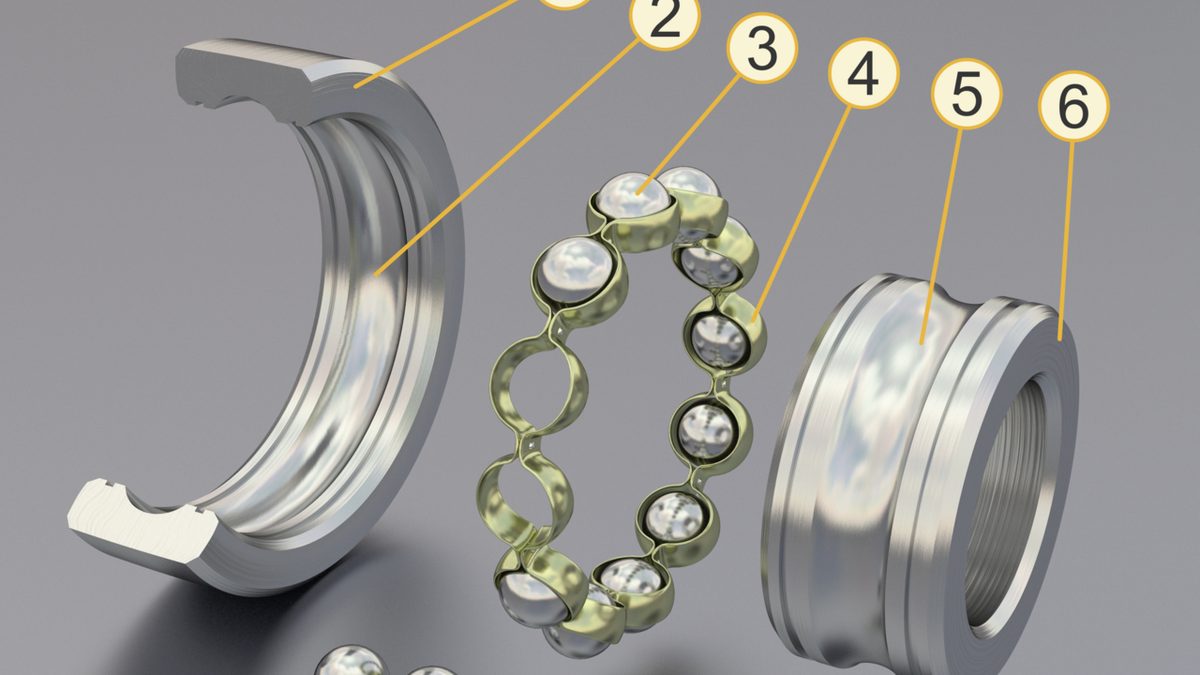
When a machine stops unexpectedly, the bearings are one of the first places to look. Under every rotating shaft there is a bearing that sooner or later wears out, and most of the time the real culprit is not the bearing itself but its fitting, its lubrication or the load on it. In this post we start with what is inside a bearing and work through how to read its number, how to fit it correctly, and what the marks on it tell you when you take it out.
What is a bearing and what does it do?
A bearing is a machine element that reduces friction between a rotating part and a stationary part by turning sliding into rolling. Thanks to the balls or rollers placed between two rings, the coefficient of friction drops to about a tenth of that of a plain bearing. That means less heat, less power loss and a longer life.
Every bearing has four basic parts:
Most bearings add a sealing element to these four parts: a seal or metal shield that keeps dirt out and grease in.
Bearing types and where each is used
What decides the choice of bearing is the direction of the load. A load perpendicular to the shaft is radial; a load along the shaft axis is axial. Which load a bearing can carry, and how much, depends on its internal geometry.
Beyond these four types, there are two more you will meet often. The self-aligning ball bearing tolerates angular misalignment between shaft and housing thanks to the spherical raceway of its outer ring; it is a lifesaver on long shafts or where housings cannot be perfectly aligned. The thrust ball bearing carries only axial load and cannot take radial load at all; it is used in places such as crane hooks and turntables.
| Type | Radial load | Axial load | Speed | Misalignment tolerance |
|---|---|---|---|---|
| Deep groove ball | Good | Low | Very high | Very low |
| Angular contact ball | Good | High, one direction | High | None |
| Cylindrical roller | Very high | None | High | Very low |
| Tapered roller | Very high | High | Medium | None |
| Self-aligning ball | Medium | Low | High | High (2–3°) |
| Thrust ball | None | Very high | Low | None |
How to read a bearing number
The number on the side face of a bearing is its identity. Without looking at a catalogue, you can work out its bore, series and shield type from the number alone. Let us go through the example you will meet most often:
The rule of multiplying the last two digits by 5 applies from 04 upwards. Codes 00, 01, 02 and 03 correspond to 10, 12, 15 and 17 mm respectively and have to be memorised. Of the shield codes, 2RS means rubber seals on both sides, 2Z means metal shields on both sides, and no code means an open bearing. Sealed bearings are greased and closed at the factory and are not relubricated.
Do not overlook the C3 clearance class. If you fit a normal-clearance bearing where it runs hot, the inner ring can expand and take up the clearance, and the bearing seizes within its first hours. That is why most electric motors come with C3.
Fitting: most bearings die while being fitted
The biggest cause of early bearing failure is incorrect fitting. The rule fits in one sentence: apply the force to the ring with the interference fit, and never let it pass through the balls.
If you are fitting the bearing on a shaft, the tight fit is on the inner ring, so you must apply the driving force to the inner ring. If you are fitting it into a housing, the force goes on the outer ring. If you press through the wrong ring, the force passes through the balls and leaves dents on the raceway that are hard to see. The bearing looks normal at that moment and starts making noise a few weeks later.
Rules to follow when fitting
- Clean the shaft and housing surfaces; leave no burrs or rust.
- Measure the shaft diameter with a micrometer and confirm it is within tolerance. A bearing fitted on a worn shaft creeps, heats up and eats the shaft.
- Do not take the bearing out of its packaging until the moment you fit it; a bearing left open on the bench collects dust.
- Where possible, choose heat fitting over mechanical driving. Bring the bearing to 80–100 °C in an induction heater or an oil bath; the expanded inner ring slides onto the shaft without force. Do not exceed 120 °C, or the material loses hardness.
- If you have to drive it on, use a fitting sleeve that matches the bearing ring; never hit it directly with a hammer.
- After fitting, turn the shaft by hand; if you feel any catching or roughness, take it off and do not run it until you have found the cause.
Failure marks: what a removed bearing tells you
When a bearing fails, spend five minutes examining it before throwing it away. The marks on the raceway tell you the cause of the failure almost for certain and stop you repeating the same mistake.
The most useful clue for telling these patterns apart is regularity. If the marks repeat at exactly the same spacing as the balls, the bearing was not turning at the time; so the culprit is a fitting blow or vibration while the machine was standing. If the marks are irregular and randomly scattered, the bearing was damaged while running; start looking at load, lubrication or dirt.
Lubrication: neither too little nor too much
About a third of bearing failures are caused by lubrication, and a large share of those come from too much grease. The grease becomes an obstacle that the balls have to keep churning through, which raises friction and temperature.
Rule of thumb: fill 30–50% of the bearing's free space with grease, and at most half of the housing. At high speed stay near the lower limit; at low speed and heavy load go towards the upper limit.
The relubrication interval changes with speed and diameter. For a rough guide you can use this table, but the manufacturer's catalogue always takes priority:
| Operating temperature | Effect | Relubrication interval |
|---|---|---|
| Up to 70 °C | Normal | Catalogue value |
| 85 °C | Grease life halves | Half |
| 100 °C | Grease life drops to a quarter | A quarter |
That grease life halves with every 15 °C rise in temperature is a fact often left out of maintenance plans. If you keep greasing a hot-running bearing at the same interval, the bearing runs dry between greasings.
Do not mix greases with different soap bases. A lithium-based and a calcium sulphonate-based grease may each be fine on their own, but mixed together they can lose consistency and run. If you are changing grease, clean the housing out completely.
Life calculation: what is L10?
The life value in the catalogue is not a guarantee but a statistical expectation. L10 is the life that 90% of identical bearings running under the same conditions will reach, and 10% will fall short of.
The basic formula, in millions of revolutions, is:
L10 = (C / P)^p

C = dynamic load rating (from the catalogue, N)
P = equivalent dynamic load (N)
p = 3    for ball bearings
p = 10/3 for roller bearings
To convert the result to hours:
L10h = (10^6 / (60 × n)) × (C / P)^p

n = speed (rpm)
Worked example
A 6204 bearing runs on a fan shaft turning at 1450 rpm under a radial load of 900 N. From the catalogue, C = 12,700 N.
C / P   = 12700 / 900 = 14.11
(14.11)^3 = 2809

L10h = (1,000,000 / (60 × 1450)) × 2809
     = 11.49 × 2809
     ≈ 32,300 hours  (~3.7 years non-stop)
The key point here is that the exponent is 3: double the load and the life drops to one eighth. Extra load on the bearing from shaft misalignment, an unbalanced pulley or an overtightened belt pulls the life far below the catalogue value. In practice very few bearings reach their L10 life, because lubrication, dirt and alignment usually come into play before fatigue does.
Removal
The rule is the same when removing a bearing, only the direction changes: apply the pulling force to the ring with the interference fit. On a bearing being removed from a shaft, the puller's jaws must sit on the inner ring. If you pull on the outer ring, the force again passes through the balls.
- Use a three-jaw puller where possible, and make sure the jaws grip the inner ring fully.
- With a seized bearing, heating the inner ring with an induction heater is much safer than forcing it.
- Do not refit a removed bearing. Removal almost always damages the raceways.
- If a bearing has failed, measure the shaft and housing bore as well; fitting a new bearing in a worn seat soon brings the same failure back.
Quick checklist
- Determine the direction of the load; if there is axial load, do not try to make do with a deep groove ball bearing.
- Check the bore, shield type and clearance class from the number. Use C3 where it runs hot.
- Measure the shaft and housing diameters with a micrometer and check they are within tolerance.
- Heat-fit where possible; if you have to drive it on, put the force on the right ring.
- Fill 30–50% of the bearing's free space with grease; more does harm.
- If the operating temperature exceeds 70 °C, shorten the relubrication interval.
- Read the marks on a failed bearing before throwing it away; fitting a new one without finding the cause repeats the same failure.
Chosen and fitted correctly, a bearing is a cheap part that runs for years without trouble. Almost all early failures come from fitting, lubrication or alignment, in other words from preventable causes. Spending a few minutes examining every bearing you remove is the cheapest way to prevent the next failure.
Frequently asked questions
Why do bearings fail early?
Most early failures come from poor or contaminated lubrication, incorrect fitting (hammering, forcing through the wrong ring), contamination and misalignment. Reaching the true fatigue life is less common.
What is the difference between 2RS and ZZ?
2RS has rubber seals on both sides, ZZ has metal shields. Sealed bearings protect better against dust and water but have slightly more friction and a lower speed limit; ZZ runs faster but does not keep out liquids.
To what temperature can a bearing be heated for fitting?
80–100 °C in an induction heater or oil bath is enough; the expanded inner ring slides onto the shaft without force. Do not exceed 120 °C or use an open flame, as the steel loses hardness.
Sources
This article is a compilation based on the sources below and personal experience; its assessments are opinions. In practice, the manufacturer's official documentation and applicable regulations take precedence.
- ISO 281 — Rolling bearings: Dynamic load ratings and rating life
- ISO 15243 — Rolling bearings: Damage and failures, terms and characteristics
- ISO 5753-1 — Rolling bearings: Internal clearance
- SKF — Rolling bearings (general catalogue)
Calculator: Bearing number decoder shows the type, bore, dimensions and suffix meanings as you type a number.
Comment
No comments yet. Be the first to comment!
Leave a comment