
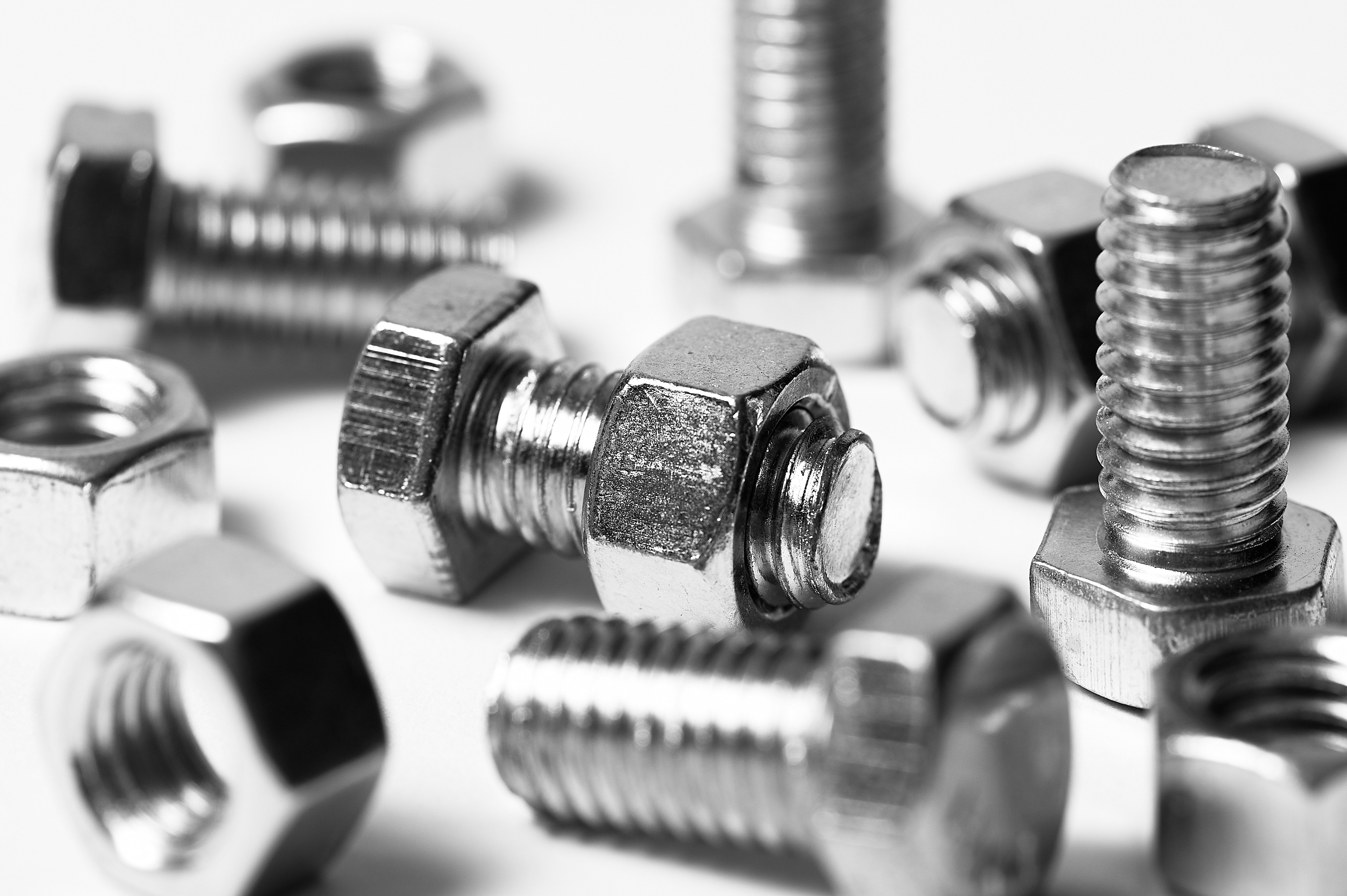
The bolt is one of the most basic fasteners in mechanical and structural engineering. We come across dozens of them every day yet rarely give them a thought; chosen wrongly, these small parts can cause serious failures and even workplace accidents.
What Is a Bolt?
A bolt is a fastener with a helical thread cut along its cylindrical shank and a head at one end. Used with a nut or a threaded hole, it holds two or more parts together. It is often confused with a screw; the basic difference is that a bolt is used with a nut, while a screw is driven into a thread it cuts itself or into a pre-drilled hole.
A bolt has three main parts:
- Head: The part the wrench grips and where the tightening torque is applied.
- Shank: The part that passes through the joined components. It can be fully or partly threaded.
- Thread: The helical profile that locks with the nut. In metric standards it is marked with the letter M (M8, M10, M12…).
What Is It Used For?
The main job of a bolt is to make a joint that can be taken apart. Unlike permanent methods such as welding or riveting, a bolt-and-nut joint is preferred wherever maintenance, repair or part replacement is needed. The range of uses is very wide:
- Machine frame and cover joints
- Flange joints (pipes, valves, pumps)
- Vehicle and construction machinery chassis joints
- Structural steel and bridge structures
- Electrical panel and equipment mounting
- Wind turbines and solar panel supports
What Materials Are They Made From?
The bolt material is chosen according to the load, the working environment and the budget.
Carbon Steel
The most common material. It is divided into low, medium and high carbon by carbon content. Low-carbon steel (C < 0.25%) is easy to form and is used where low strength is enough. Medium- and high-carbon steels are hardened by heat treatment to reach the high-strength classes (8.8, 10.9, 12.9).
Alloy Steel
Steels whose mechanical properties are improved by adding alloying elements such as chromium (Cr), molybdenum (Mo) and nickel (Ni). Most of the high strength classes (10.9, 12.9) are made from alloy steel.
Stainless Steel
Chosen when corrosion resistance is critical. The two most common groups:
- A2 (304): General corrosive environments, the food industry, indoors.
- A4 (316): Environments containing chlorine and salt, seawater applications.
The strength class of stainless bolts is given as 70 or 80 (e.g. A2-70, A4-80).
Brass
Thanks to its electrical conductivity, corrosion resistance and non-magnetic structure, it is used in electrical panels, plumbing and the chemical industry. Its mechanical strength is low compared with steel.
Aluminium
Chosen when weight is critical (aerospace, automotive). It is light and corrosion-resistant, but its strength is far below that of steel.
Titanium
Offers a high strength-to-weight ratio and excellent corrosion resistance. It is used in aerospace, medical devices and racing vehicles. It is expensive.
Strength Classes (ISO 898-1)
The mechanical properties of steel bolts are classified by the ISO 898-1 standard. The two numbers on the head show the class:
- First number × 100 = Minimum tensile strength (MPa)
- First number × second number × 10 = Minimum yield strength (MPa)
| Class | Min. Tensile Strength | Min. Yield Strength | Material | Typical Use |
|---|---|---|---|---|
| 4.6 | 400 MPa | 240 MPa | Low-carbon steel | Light structural joints |
| 5.6 | 500 MPa | 300 MPa | Medium-carbon steel | General machine applications |
| 6.8 | 600 MPa | 480 MPa | Medium-carbon steel | Medium load-bearing joints |
| 8.8 | 800 MPa | 640 MPa | Medium-carbon / alloy steel (quenched + tempered) | Industrial machinery, vehicles — the most common class |
| 10.9 | 1000 MPa | 900 MPa | Alloy steel (quenched + tempered) | High-load, vibrating joints |
| 12.9 | 1200 MPa | 1080 MPa | Alloy steel (quenched + tempered) | Critical joints, aerospace, racing vehicles |
Note: Class 8.8 covers the great majority of industrial applications. Classes 10.9 and 12.9 are stronger but more prone to brittle fracture; they must not be over-torqued.
Surface Treatments
Bare steel bolts rust quickly when exposed to corrosion. Choosing the right surface treatment for the working environment directly affects service life:
- Zinc electroplating (clear/yellow zinc): The most common protection. Enough for dry indoor environments.
- Hot-dip galvanising (HDG): A thicker zinc layer, suitable for outdoor and damp environments. Preferred for large bolts.
- Dacromet / Geomet: A chromium-free coating with high corrosion resistance. Common in the automotive and wind energy sectors.
- Phosphating (black phosphate): Usually used together with oil; low corrosion resistance, suitable for indoor use.
- Nickel plating: Decorative appearance and moderate corrosion resistance.
Common Head Types
The shape of the bolt head determines the torque that can be applied, the access angle and the tool used:
- Hex: Tightened with a standard wrench or socket set. The most widely used type in industry.
- Hex flange: Has an integrated washer underneath; it increases the bearing surface and stops the washer from slipping under vibration.
- Socket head (Allen / hex socket): Preferred in tight spaces and for high-torque tightening.
- Torx: Less likely than a hex socket to let the tool slip; common in automotive and power tools.
- Phillips and slotted: Generally used for low-torque applications in thin sheet metal and plastics.
Choosing the Right Bolt
The main criteria to consider when choosing a bolt are:
- Load: Static or dynamic? Is there vibration?
- Working environment: Moisture, salt, chemicals, high temperature…
- Size: Diameter (M series) and length are set by the part geometry.
- Strength class: Choose the minimum class for the calculated load; an unnecessarily high class adds cost.
- Removability: Depending on how often it is serviced, consider the surface treatment and the need for an anti-seize lubricant.
- Standards compliance: Follow ISO, DIN or the project specification.
Choosing the right bolt and applying the right tightening torque are the two basic conditions for a reliable joint. Use manufacturer tables or calculation methods such as VDI 2230 so that the tightening torque is neither exceeded nor left too low.
Frequently asked questions
What does 8.8 on a bolt mean?
The first number is one hundredth of the tensile strength (8 → about 800 MPa) and the second is the ratio of yield to tensile strength (0.8). So an 8.8 bolt yields at about 640 MPa.
Is a stainless bolt always better?
No. A2 and A4 stainless bolts resist corrosion but are usually weaker than an 8.8 steel bolt. Strength class matters most in critical load-bearing joints; corrosion resistance matters in wet or chemical environments.
Which nut class should be used?
The nut class should equal or exceed the bolt's: class 8 nuts for 8.8 bolts, class 10 for 10.9. With a weaker nut the threads can strip before the bolt fails.
Sources
This article is a compilation based on the sources below and personal experience; its assessments are opinions. In practice, the manufacturer's official documentation and applicable regulations take precedence.
- ISO 898-1 — Mechanical properties of fasteners made of carbon steel and alloy steel: Bolts, screws and studs
- ISO 3506-1 — Mechanical properties of corrosion-resistant stainless steel fasteners
- VDI 2230 Blatt 1 — Systematic calculation of highly stressed bolted joints
Calculator: Bolt tightening torque calculator works out torque and preload from size, property class and friction.
Comment
No comments yet. Be the first to comment!
Leave a comment